A Follow-Up from the Burlington Chamber of Commerce Advocacy Committee
First, we want to take a moment to say thank you.
Since sharing our advocacy update on October 6 regarding the City of Burlington's proposed 2027 budget, we've heard from business owners, Chamber members, residents, and community members who have taken the time to ask questions, share information, and contribute to this important conversation. We appreciate everyone who has helped bring additional information forward. It's exactly this kind of community engagement that allows us to take a closer look at the issues affecting Burlington and make sure the people who live, work, and do business here have access to meaningful information.
Thanks to those conversations and additional publicly available information, we now have more details to share about the proposed tax changes, how Burlington compares to neighboring cities, and what these proposals could potentially mean for our local businesses and residents.
There's quite a bit to unpack, so let's take a closer look.
First, What Is Actually Being Proposed?
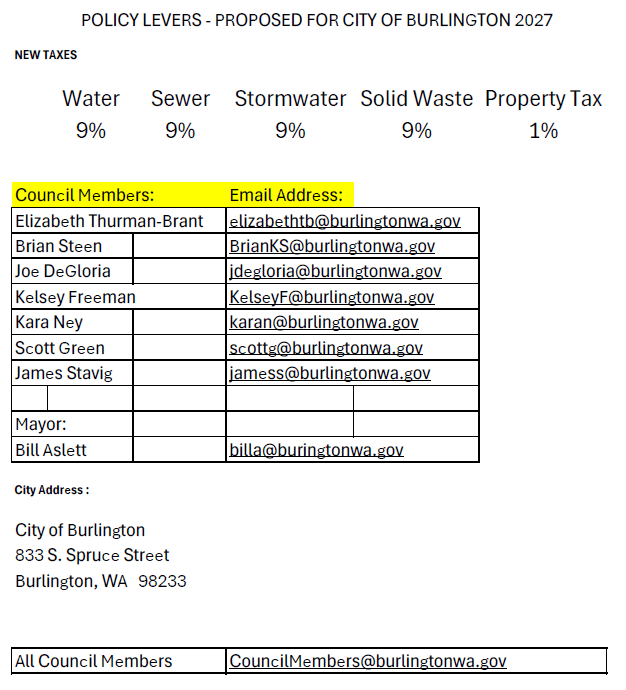
During the City's recent budget workshop, several proposed tax changes were discussed as part of the planning process for 2027.
The proposals include four new 9% utility taxes, along with a proposed 1% increase in the City's property-tax levy.
| Tax Category | Current Listed Tax | Proposed Tax |
|---|---|---|
| Water | 0% | 9% |
| Sewer/Wastewater | 0% | 9% |
| Stormwater | 0% | 9% |
| Solid Waste | 0% | 9% |
| City Property-Tax Levy | Existing levy | 1% proposed increase |
Before going any further, there's an important distinction to make. The proposed 9% figures are utility taxes, which are different from increases to the actual rates charged for utility services. Similarly, a 1% increase in the City's property-tax levy doesn't automatically mean every property owner's total tax bill would increase by 1%.
And perhaps most importantly, these are proposals, not approved changes.
The City Council will ultimately be responsible for approving the 2027 budget before the end of the year. That means there is still time for questions, discussion, and community input.
How Does Burlington Compare to Our Neighbors?
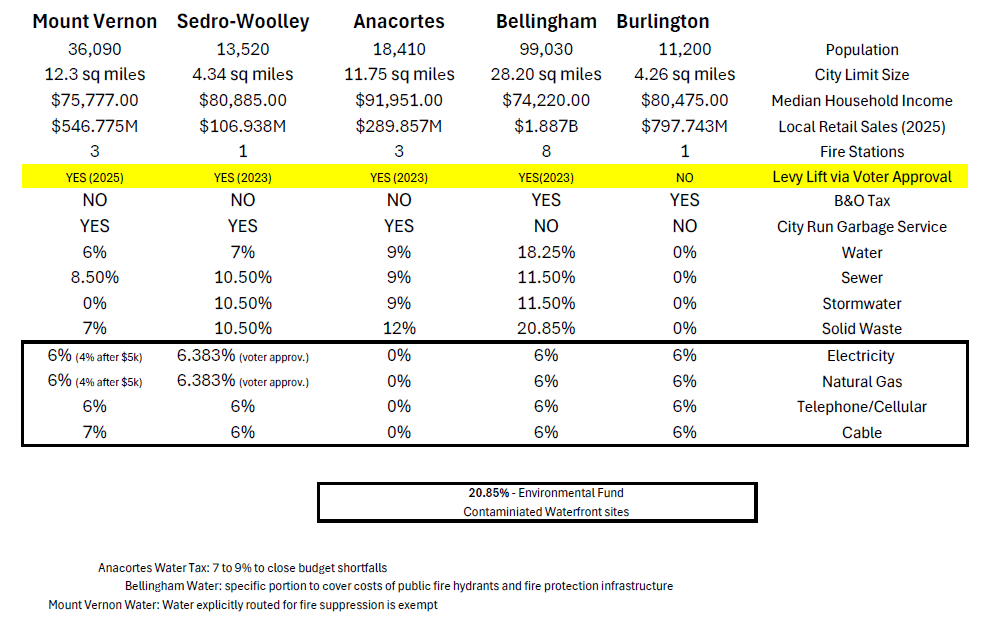
One of the comparisons presented during the budget discussion looked at utility taxes in nearby cities, including Mount Vernon, Sedro-Woolley, Anacortes, and Bellingham.
Additional information shared with the Chamber provides a clearer picture of those comparisons.
| City | Water | Sewer | Stormwater | Solid Waste |
|---|---|---|---|---|
| Mount Vernon | 6% | 8.5% | 0% | 7% |
| Sedro-Woolley | 7% | 10.5% | 10.5% | 10.5% |
| Anacortes | 9% | 9% | 9% | 12% |
| Bellingham | 18.25% | 11.5% | 11.5% | 20.85% |
| Burlington (Existing) | 0% | 0% | 0% | 0% |
| Burlington (Proposed) | 9% | 9% | 9% | 9% |
At first glance, these numbers might make Burlington's proposed rates appear fairly comparable to those of surrounding communities. Some cities currently have higher percentages, while others have lower rates depending on the utility.
But there's more to the story than percentages.
Each of these communities has its own population, geographic size, infrastructure needs, municipal services, and approach to funding those services.
For example, Mount Vernon, Sedro-Woolley, and Anacortes are identified as operating city-run garbage services, while Burlington and Bellingham do not. The comparison also identifies certain utility taxes in neighboring cities that are connected to specific municipal expenses, including fire protection infrastructure and environmental programs.
Those differences matter because two cities charging the same percentage aren't necessarily providing the same services or using the resulting revenue in the same way.
Regional comparisons can be helpful, but understanding what the taxes fund and why they're needed is just as important as understanding the rates themselves.
Burlington Is a Little Different, and the Numbers Show It
Here's where the conversation becomes especially interesting for our local business community... according to the comparison information provided,
Burlington has approximately 11,200 residents and covers just 4.26 square miles. Our median household income is listed at $80,475.
Now consider this: Burlington's local retail sales for 2025 are listed at approximately $797.7 million.
For comparison, Mount Vernon, with a population of approximately 36,090 residents, is listed as generating approximately $546.8 million in local retail sales during that same period.
That's a significant amount of retail activity happening in a relatively small city.
Anyone familiar with Burlington knows that our businesses serve far more than just the people who live within city limits. We are a destination for shopping, dining, services, and employment for people throughout Skagit County and beyond. This is one of the reasons looking at Burlington's budget and tax structure through the lens of its residential population alone doesn't tell the complete story.
Our local businesses play an important role in the regional economy, and decisions that affect their operating expenses can have implications beyond Burlington's geographic boundaries.
So, What Could This Mean if You Own a Business in Burlington?
For business owners, the conversation becomes a little more personal when we move away from percentages and start talking about actual expenses.
Every business operates differently. A restaurant or food-service business may rely heavily on water, sewer, and solid waste services, while a retail store or professional office might have a very different utility footprint. But regardless of the type of business, utilities are part of the cost of keeping the doors open.
Let's use a simple illustration.
If a business currently has $1,000 per month in combined utility charges that would be subject to the proposed taxes, a 9% cost passed through on those charges would represent approximately $90 more each month, or $1,080 annually.
For a business with $1,500 in those same eligible monthly charges, the illustrative impact would be $135 per month, or $1,620 annually.
These are examples to help put the percentages into perspective, not projections of actual future bills. The way each proposed tax would be assessed, and how much of that expense would ultimately be passed along to utility customers, still needs clarification. It's also important to understand that four separate 9% utility taxes don't automatically mean a 36% increase to someone's overall utility expenses. Each proposed tax would apply to its respective taxable service.
But even without knowing the final impact, we recognize why business owners are asking questions.
For a small business, additional operating expenses don't exist in isolation.
They become part of decisions about pricing, staffing, purchasing equipment, making improvements, and planning for growth. And for businesses already navigating rising costs in other areas, understanding the cumulative impact matters.
And What About Those Who Call Burlington Home?
Businesses aren't the only ones who may be affected by the proposals.
For Burlington residents, utilities are part of the household budget, whether that's water and sewer service, garbage collection, or other monthly expenses.
Using another simple illustration, if a household currently has $200 in combined monthly utility charges subject to the proposed taxes, an equivalent 9% cost passed through would mean approximately $18 more per month, or $216 over the course of a year.
Again, this is an example rather than an estimate of what any particular household should expect to pay. Actual costs would depend on how the proposed taxes are implemented and which charges are subject to them.
There's also the proposed 1% increase in the City's property-tax levy to consider.
It's worth emphasizing that an increase to the City's levy isn't the same thing as an identical percentage increase on every homeowner's property-tax bill.
Property taxes involve multiple taxing districts, property assessments, and other factors that influence what an individual property owner ultimately pays.
For renters, the potential impact could look different as well, depending on which utilities they pay directly and how property-related expenses are handled through their rental agreements.
Whether you own a home, rent, or operate a business, the question is similar: What would these changes actually look like in dollars and cents?
That's one of the answers we're hoping to better understand as the budget process continues.
There's Another Piece of Burlington's Tax Structure Worth Understanding
When comparing Burlington with other cities, we also need to consider taxes that already exist.
Burlington currently has a local Business & Occupation (B&O) tax, which is separate from the Washington State B&O tax that applies to businesses throughout the state. Of the five cities included in the regional comparison, only Burlington and Bellingham are identified as having a local B&O tax.
Burlington is the only Skagit County city in this particular comparison with that additional business tax.
Burlington also already has 6% utility taxes on electricity, natural gas, telephone/cellular service, and cable. Those existing taxes are separate from the four new 9% utility taxes being proposed for 2027.
Why is this distinction important?
Because when evaluating the cost of operating a business in Burlington, or the overall tax burden on residents, we need to look at the full picture. That includes existing taxes, proposed new taxes, utility charges, and how those expenses fit together.
A comparison of one tax rate tells us something. A broader understanding of the overall cost of doing business and living in Burlington tells us much more.
What Do We Still Need to Know?
During the recent budget workshop, discussion also included a proposal for nine additional City positions.
According to information available to us as of October 6, the full proposed budget had not yet been presented to the City Council. While the proposed tax rates have generated understandable questions and discussion, there's still more information needed to fully understand the financial picture.
Our Chamber Advocacy Committee has already submitted questions to the Mayor and City Administration seeking additional clarification.
Among the areas we believe deserve further discussion are how much revenue each proposed tax would generate, what specific programs or services that revenue would support, and how the additional funding relates to the City's proposed expenses and staffing needs. We also want to better understand whether separate utility-rate increases are being considered, what the actual impact could look like for different types of businesses and households, and what alternative approaches to addressing budget needs have been evaluated.
These are important questions, and we believe they deserve clear answers as part of the public budget process.
We recognize that developing a municipal budget involves balancing many competing needs. Maintaining infrastructure, providing essential services, planning for growth, and managing public resources all come with real costs.
At the same time, those decisions affect the people and businesses that ultimately help fund those services.
The Burlington Chamber of Commerce has not taken a formal position for or against the proposed increases. Our current focus remains on gathering accurate information, understanding the potential impacts, and ensuring our members have an opportunity to be heard.
The Budget Process Is Still Underway, and Your Voice Matters
One of the reasons we're continuing to share information is that these conversations are happening now, while the 2027 budget is still being developed and considered.
That makes community participation especially important.
If you own or operate a business in Burlington, we encourage you to share how potential changes to utility costs and local taxes could affect your operations. Whether you have specific financial concerns, questions about the proposals, or simply want more information, your perspective helps us better represent our business community.
Business owners can share their feedback through our brief Chamber advocacy survey:
Share Your Business Feedback Here
For Burlington residents and homeowners, we welcome your perspectives as well. You can share your questions or concerns with the Chamber at steph@burlington-chamber.com.
Community members can also reach out directly to the Burlington City Council at CouncilMembers@burlingtonwa.gov to share their thoughts on the proposed budget and tax changes.
If you missed our original update, you can read it here:
Burlington 2027 Budget: We Want Your Feedback
Thank You for Being Part of the Conversation
We want to close where we began, with a sincere thank you.
To the Chamber members, business owners, residents, and community members who have reached out, shared information, asked questions, or taken the time to become more informed, we appreciate you.
Community advocacy isn't just about raising concerns. It's about sharing information, understanding different perspectives, asking thoughtful questions, and working toward decisions that support the long-term health of our community.
We appreciate the work involved in preparing the City's budget, and we recognize that these are not always easy conversations. Our hope is that continued transparency, meaningful public discussion, and a willingness to hear from those affected will remain central to the process.
As additional information becomes available, the Burlington Chamber of Commerce will continue to share updates, listen to our members, and help ensure our business community stays informed and engaged.
An informed community is an engaged community, and your voice is an important part of Burlington's future.
Burlington Chamber of Commerce
Advocating for a Stronger Business Community